
Total Life Sync
The 20-Minute Home Workout That Fits Any Schedule
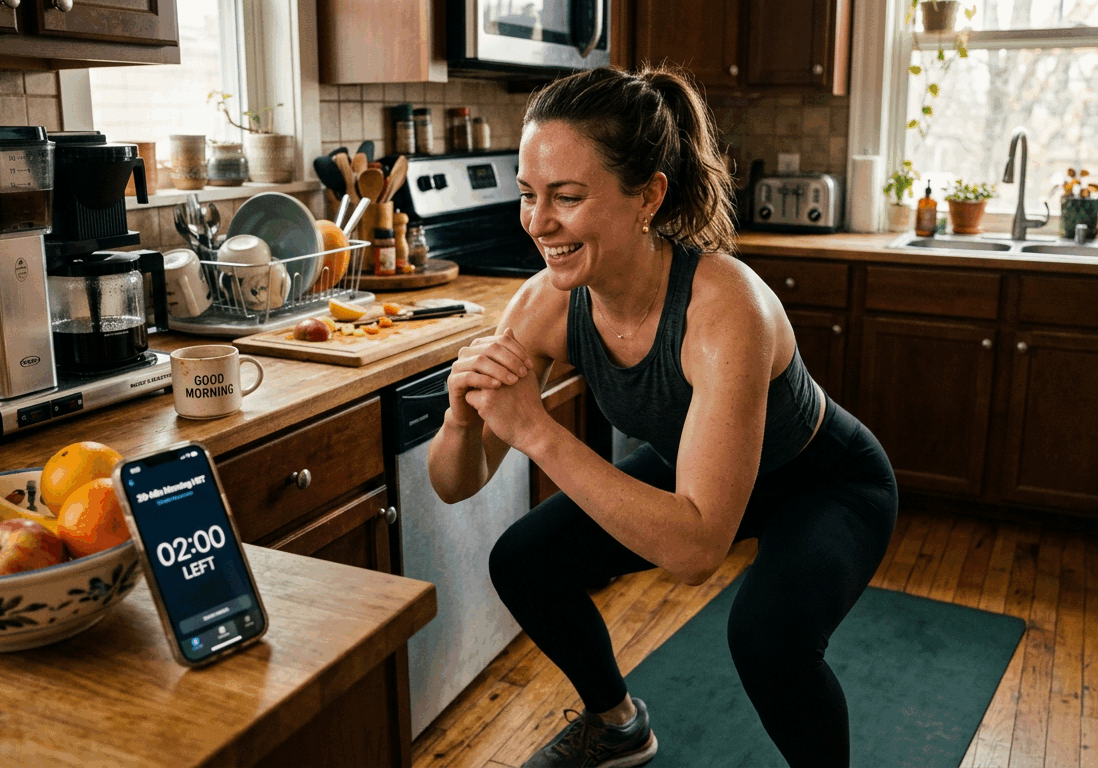
Twenty minutes sounds almost too short to matter. Most people's mental model of a real workout involves at least an hour, a change of clothes, a warmup, a cooldown, and ideally a commute to somewhere with proper equipment. The idea that a 20-minute home workout could produce meaningful results runs against that picture entirely.
It runs against it incorrectly. Twenty focused minutes of the right kind of exercise is not a consolation prize. For most people's goals and schedules, it is entirely sufficient, and it is vastly better than the longer workout that never actually happens because there is not enough time for it.
Why a 20-Minute Home Workout Is Enough
The relationship between workout duration and results is not linear. The first twenty to thirty minutes of a well-designed session produce the majority of the training stimulus. Additional time adds diminishing returns, not proportional additional benefit. For someone whose goal is general health, weight management, and maintaining functional fitness, twenty minutes of compound movement done consistently produces excellent results over time.
The key variables are intensity and exercise selection. A 20-minute home workout using compound exercises that challenge multiple muscle groups simultaneously, with minimal rest between sets, is a meaningfully different physiological stimulus from twenty minutes of isolated, low-intensity movement.
How to Structure an Effective Short Workout Routine
A practical structure for a 20-minute home workout uses three to four compound exercises in a circuit format. You move from one exercise to the next with minimal rest, completing a round before resting briefly and repeating. This keeps heart rate elevated throughout, combining strength and cardiovascular stimulus in a single efficient session.
A simple example: squats for 45 seconds, push-ups for 45 seconds, a hip hinge or glute bridge for 45 seconds, and a row or pulling movement for 45 seconds, with 15 seconds of transition between exercises. Rest 60 to 90 seconds after each complete round. In 20 minutes you complete four to five rounds. That represents meaningful, productive work.
Exercise Selection for a Quick Home Workout
For short workouts to be effective, every exercise needs to earn its place. Prioritise movements that involve multiple joints and large muscle groups simultaneously. Squats and their variations, push-up variations, hip hinge movements, rows, and lunges are the foundation. Single-joint isolation exercises have their place in longer sessions. They are a poor use of limited time in a 20-minute circuit.
Making It Progressive Over Time
The same 20-minute workout done for months produces progressively fewer results as your body adapts. Build progression by making exercises gradually more challenging. Bodyweight squats become split squats, which become Bulgarian split squats. Standard push-ups become elevated feet push-ups. Adding a resistance band or dumbbells opens additional progression options. Track what you do and how it felt. Use that as the basis for progression rather than guessing whether you are improving over time.







This site shares personal research and opinion, not medical advice. It also contains affiliate links, meaning we may earn a commission if you purchase through our links, at no additional cost to you. Always consult your doctor before making any health changes.
©2026 Total Life Sync | All Rights Reserved